


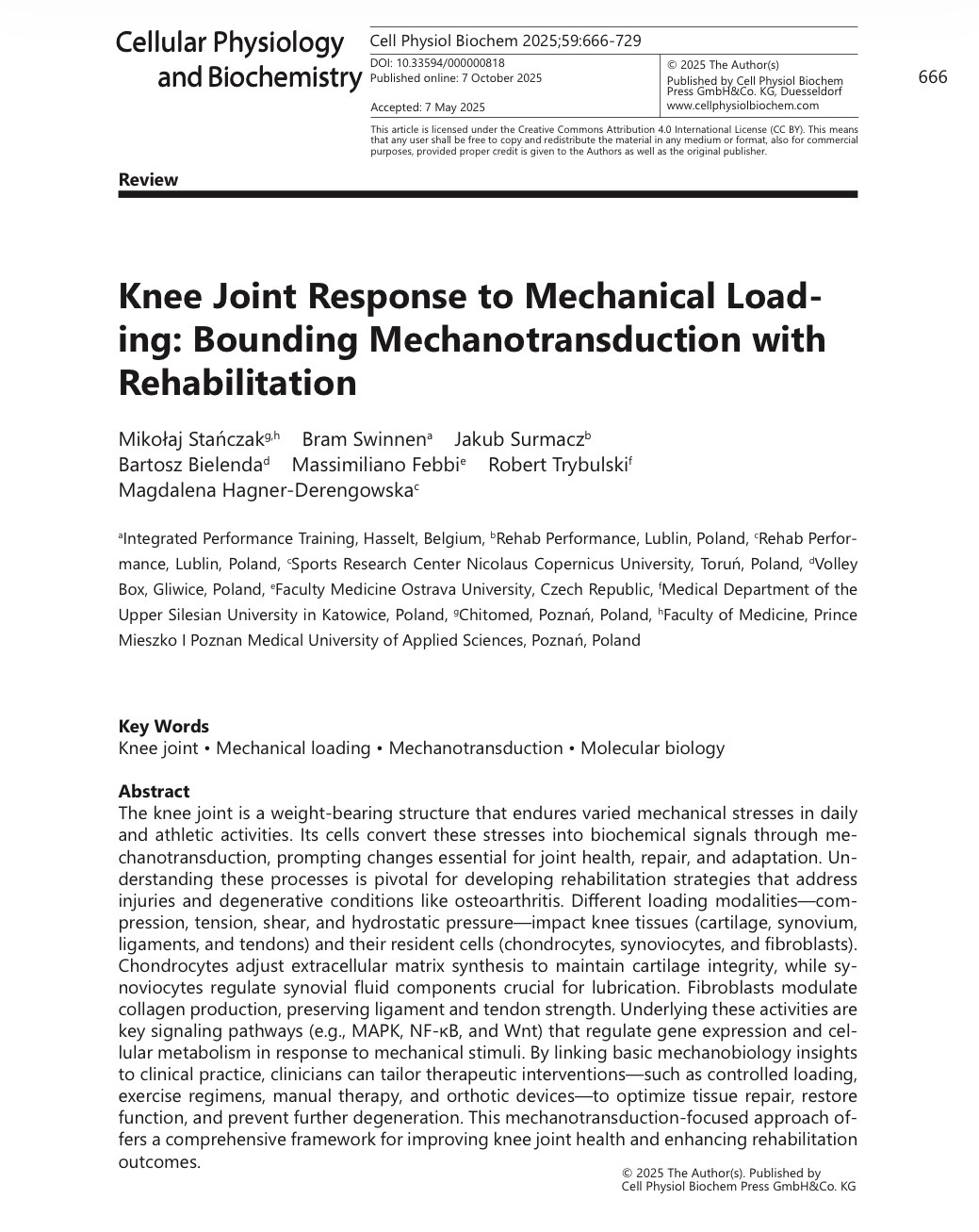
Tissue doesn’t adapt to exercises — it adapts to mechanical signals.
How mechanotransduction explains what truly drives knee recovery.
Tissue doesn’t adapt to exercises — it adapts to mechanical signals.
How mechanotransduction explains what truly drives knee recovery.
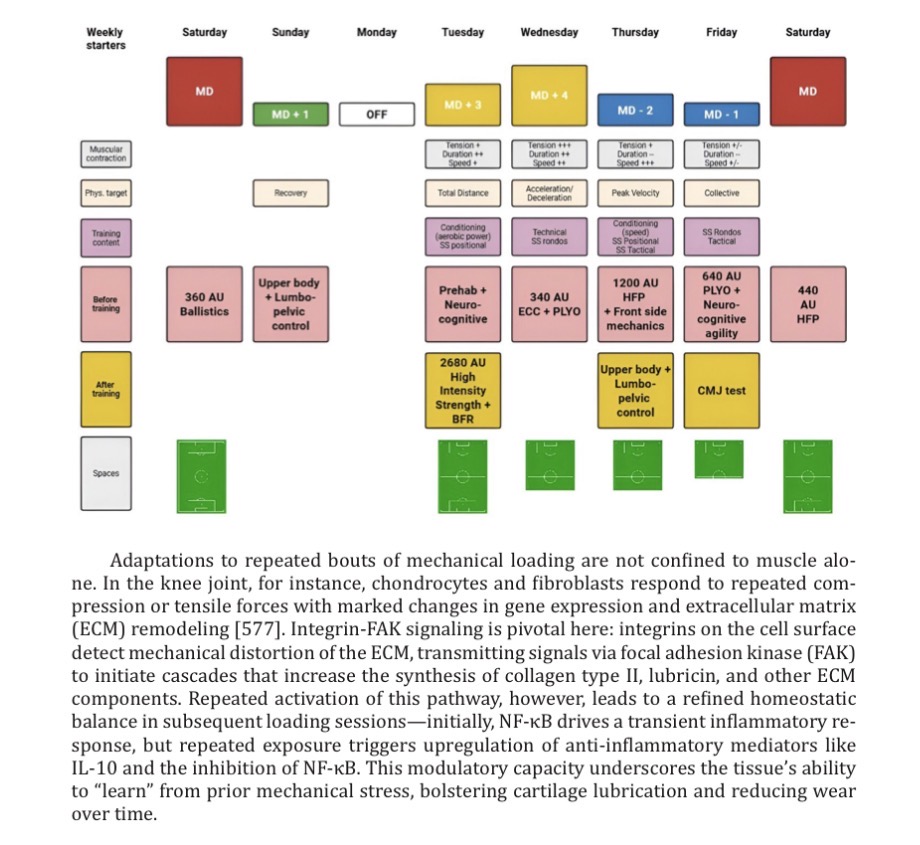
I’m proud to share our new publication on knee mechanotransduction and rehabilitation.
Together with Mikołaj Stańczak, Jakub Surmacz, Bartosz Bielenda, Prof.Dr. Massimiliano Febbi PhD, Robert Tribulski, Magdalena Hagner-Derengowska, we explored one key question:
How can mechanical loading — at the molecular level — accelerate knee rehabilitation?

Because rehab isn’t only about exercises.
It’s about delivering the right mechanical signal at the right biological time.
Different tissues — cartilage, synovium, meniscus, tendons, ligaments — all respond in very specific ways to load.
That’s why we argue for stage-specific mechanobiology:
🔁 Match the loading strategy to the phase of healing — inflammation, proliferation, remodeling.
This is how you optimize tendon, ligament and cartilage recovery instead of guessing with sets and reps.
🧩 What makes this review practical?
We translated molecular mechanisms into clinical tools:
✔️ Clear loading windows for under-loaded, optimal and overloaded tissue
✔️ Strength & plyometric guidelines per healing phase
✔️ How to dose early loading after ACL, meniscus or tendon injuries
✔️ How manual therapy + exercise interact through mechanotransduction
✔️ How controlled mechanical stress prevents long-term joint degeneration
The goal:
👉 Build smarter rehab, not more rehab.
👉 Give tissues the mechanical signal they need — exactly when they can use it.
If you work in physiotherapy, sports medicine or performance, this framework will help you design more precise and effective loading progressions.


