Hamstring Progression Series

This progressive training series introduces four key exercises designed to strengthen the hamstrings in functional, sprint-specific contexts. Each exercise targets neuromuscular control, pelvic mechanics, posterior chain strength, and long-length loading—critical elements for both performance and injury reduction.


Exercise 1: Good Morning

To begin the series, we start with the Good Morning — a foundational hip-hinge movement ideal for developing hamstring strength at long muscle lengths.
Before progressing to more complex variations, this exercise lays the groundwork by providing three essential benefits:

✔️ Strengthening the hamstrings in a lengthened position: The eccentric, stretch-loaded nature of the good morning promotes adaptations that may increase fascicle length, improving the muscle’s ability to tolerate high forces and potentially reducing injury risk (Vigotsky 2015)

✔️ Building posterior chain strength and resilience: The movement effectively activates the hamstrings, glutes, and spinal erectors, creating a strong foundation for more advanced patterns (McAllister 2014, Jaeggi 2024)

✔️ Preparing the neuromuscular system: Ideal for building technical control, intermuscular coordination and hip-hinge strength for more complex, unilateral movements (Llurda-Almuzara 2021).

This makes the good morning not just a strength builder, but also a valuable tool in injury prevention strategies.

And this is just the first step. In the next phases of the series, we’ll explore progressions that challenge balance and neuromuscular control, and integrate pelvic control strategies — essential for improving running mechanics and overall performance.


Exercise 2: Single-Leg Romanian Deadlift

After establishing basic long-length strength and hinge mechanics, we progress to the Single-Leg RDL — one of the most researched and effective hamstring exercises.
Its value comes from how it integrates multiple sprint-relevant qualities, making it much more than a unilateral hinge.


✔️ Posterior Chain Power: The SL RDL activates the glutes more than many other hamstring drills — even surpassing high-speed running activation (Prince 2014; Van Hooren 2022).

✔️ Eccentric Hamstring Strength: It develops eccentric strength at long muscle lengths, with high activity in the biceps femoris and other key muscles (McAllister 2014; Van Hooren 2022).

✔️ Tendon Loading & MTJ Resilience: The RDL places substantial load on the tendinous tissue of the biceps femoris long head (Chen 2023). By enhancing elastic energy storage and release, it prepares the hamstrings for the extreme forces of sprinting — addressing a key injury risk: mismatches between stiff fascicles and compliant tendons at the muscle–tendon junction (Bayrak & Yilgor Huri 2018; Kim & Kim 2022; Huygaerts et al. 2021).

✔️ Pelvic Control for Sprinting: It challenges athletes to transition from anterior to posterior pelvic tilt under load — a crucial sprint mechanic that also reduces adductor strain (Sado 2017, 2019).

✔️ Balance & Stability with Overload: The single-leg stance develops sport-specific stability and proprioception, but instability often reduces prime mover activation. The Keiser ProSquat provides controlled stability, allowing athletes to maintain single-leg specificity while truly overloading the hamstrings.

The Single-Leg RDL is not just a hamstring exercise, but a bridge between hip-dominant strength, sprint mechanics, and injury resilience.


Exercise 3: SL RDL with Ankle–Foot Complex

Once the unilateral hinge is solid, we add a key element: intrinsic foot–ankle activation. Here, the toe presses down against a sideways pull from an elastic band.

🔑 Why? Because the ankle–foot complex is the base of movement. When engaged properly, it helps to:

✔️ Control foot posture and longitudinal arch stiffness (Kelly et al., 2014)
✔️ Control big-toe motion (Hashimoto & Sakuraba, 2014)
✔️ Improve arch function and propulsive force in running (Taddei et al., 2020)
✔️ Enhance balance, stability, and performance when integrated into training (Jaffri et al., 2023)

The foot–ankle complex isn’t passive. It stores and releases elastic energy, dictates how effectively force travels through the leg, and serves as the foundation of frontside running mechanics (McKeon et al., 2015).

Training hamstrings together with the foot–ankle system means we’re preparing the athlete for real movement mechanics, not isolated strength. We address the entire kinetic chain — from pelvic control down to the foot.

👉 As McKeon et al. (2015) highlighted, intrinsic foot muscles are often ignored in both training and rehab, with interventions focusing more on external support than training the muscles to function as they are designed. This exercise directly addresses that gap.


Exercise 4: Single-Leg RDL to Step-Up

With strength, balance, and foot control established, we now integrate sprint components. This variation enhances running mechanics and hamstring resilience at long muscle lengths.

🔑 Key evidence: Developing posterior pelvic tilt (PPT) control with gym-based eccentric exercises produces greater improvements in sprint kinematics than high-volume technique drills (Mendiguchia 2022; Alt 2021). This highlights the role of strength work that teaches dynamic pelvic control — not just cueing on the track.

Why this variation?

✔️ Mimics the 2-step sprint sequence (hinge → drive)
✔️ Demands explosive PPT, which generates large hip joint forces and drives efficient power transfer (Sado 2017, 2019)

⚠️ Without good pelvic control, athletes slip into excessive anterior pelvic tilt during sprinting, which over-lengthens the hamstrings and raises their tension (≈ ST +13%, SM +26%, BF +31.5%; Nakamura 2016) — increasing both demand and injury risk.

➡️ The goal isn’t just a strong hamstring — it’s a hamstring that delivers explosive power in the right sequence, and under the right control for maximal sprint efficiency and resilience.

Neuromuscular Fatigue: The Silent Saboteur of Rehab Progress

Why do some athletes relapse into injury even after regaining full strength?
Why do ACL patients still move asymmetrically despite months of rehab?
The answer may lie in the brain, not the muscle.

🧠 Fatigue doesn’t just reduce performance — it rewires how the brain learns movement.
And when we ignore this in training or rehab, we risk hard-wiring inefficient patterns.

In this month’s newsletter, we explore how fatigue disrupts neuroplasticity, impacts motor control, and slows skill acquisition. Whether you’re rebuilding an ACL, reconditioning a player, or coaching high performers — this insight could change your approach.

🧠 Fatigue Impairs the Brain Before the Muscle

We tend to think of fatigue as purely muscular. But in reality, the nervous system fatigues first.

  • Central fatigue decreases voluntary motor drive, alters cortical excitability, and reduces reflex activity (Gandevia, 2001; Enoka & Duchateau, 2016).
  • This matters because learning or relearning movement patterns depends on the brain’s capacity to reorganize motor maps and integrate sensory feedback.
    When the brain is fatigued, those adaptations don’t occur efficiently.

🧠 Fatigue Can Hard-Wire Faulty Movement Patterns

Fatigue doesn’t just impair performance — it changes how movement is learned.
Due to reduced motor cortex and corticospinal excitability, the nervous system underestimates force, leading to overshooting and imprecise movement.
These maladaptive patterns can become encoded and reused long after fatigue has passed, slowing recovery and increasing reinjury risk (Branscheidt, 2019).

➡️ Especially in early rehab, avoid learning-based tasks under fatigue — they may engrain compensatory strategies instead of rebuilding proper control.

🧠 Fatigue and Motor Learning Compete in the Cerebellum

New research shows that fatigue perception and motor control draw on the same cerebellar resources (Casamento-Moran, 2023).
After fatiguing tasks, reduced cerebellar excitability was linked to lower perceived fatigue — but also poorer movement precision.

In short: the cerebellum might prioritize fatigue regulation over motor control under stress.
This means learning motor skills during fatigue could sacrifice movement quality, slow progress, and increase the risk of recurrence.

🚨 In ACL rehab, this has critical implications.
Post-ACLR patients already have reduced cerebellar excitability (Grooms, 2017). If we impose too much fatigue — especially during hypertrophy phases — we may worsen the neuroplastic deficits we’re trying to fix.

🚧 Motor Learning Requires a Ready Brain

Several studies show fatigue impairs motor memory and retention:

  • Roig et al. (2012): Fatigue during practice reduced retention 24–48 hours later.
  • Branscheidt et al. (2019): Muscle fatigue caused lasting motor errors and poor performance in subsequent sessions.
  • Zabihhosseinian et al. (2020): Fatigue reduced cerebellar–motor cortex interaction, slowing motor learning and retention.

🧠 The takeaway? The more fatigued the brain, the less teachable it becomes.

⚕️ Why This Matters in Rehab

Take ACL reconstruction, for example:

  • Patients already show reduced cortical excitability, impaired reflexes, and decreased motor drive (Lepley et al., 2015; Grooms et al., 2017).
  • These are signs of maladaptive neuroplasticity — neural rewiring that undermines movement control.
  • If we overload rehab with fatigue, we may deepen these deficits.

“Rehabilitation that ignores neural recovery risks hard-wiring compensatory strategies that may increase injury risk.” (Faltus et al., 2020)

🔑 Practical Takeaways for Coaches and Therapists

✅ Recognize that fatigue = reduced neural readiness and impaired learning potential.
✅ Skill acquisition is most effective when the brain is fresh, not under central fatigue.
✅ Manage fatigue as carefully as mechanical load — especially in early rehab.
✅ Use microdosing: short, high-quality bouts of motor training to promote retention without overload.
✅ Incorporate neurocognitive training to rewire faulty patterns — not just build strength.
✅ Focus on restoring motor drive and reflexive control, not just hypertrophy.
✅ Monitor signs of central fatigue: inconsistent technique, slower bar speeds, delayed reactions, reduced coordination, RSI trends. New tools like myotensiography offers real-time insights into muscle contractile properties, helping detect neuromuscular fatigue before it shows up in performance. It’s a new way to monitor neural readiness and personalize load.

✅ Periodize for the Nervous System, Not Just the Muscle
Early rehab should prioritize neuromuscular training and motor learning, not metabolic stress. When movement quality and control are restored, you can gradually layer in metabolic conditioning through sport-specific drills.
Plan heavier metabolic loads when ample recovery is available — for example, before a scheduled day off. Smart periodization respects   both physical and neural recovery, optimizing performance without reinforcing compensatory patterns.

🧭 The Big Picture

Whether you’re guiding rehab or training peak performers:
It’s not just about doing more.
It’s about teaching the nervous system to move better.
And for that, the brain must be ready to learn.


📚 Key References

  • Gandevia SC. Spinal and supraspinal factors in human muscle fatigue. Physiol Rev. 2001;81(4):1725–1789.
  • Enoka RM, Duchateau J. Translating fatigue to human performance. Med Sci Sports Exerc. 2016;48(11):2228–2238.
  • Roig M et al. Exercise-induced fatigue and motor skill retention. J Sports Sci. 2012;30(1):55–65.
  • Branscheidt M et al. Fatigue disrupts motor skill learning. eLife. 2019;8:e40578.
  • Faltus J et al. Neuroplasticity and ACL rehab. Curr Sports Med Rep. 2020;19(2):76–83.
  • Casamento-Moran A et al. Cerebellar excitability and fatigue. J Neurosci. 2023;43(17):3094–3106.

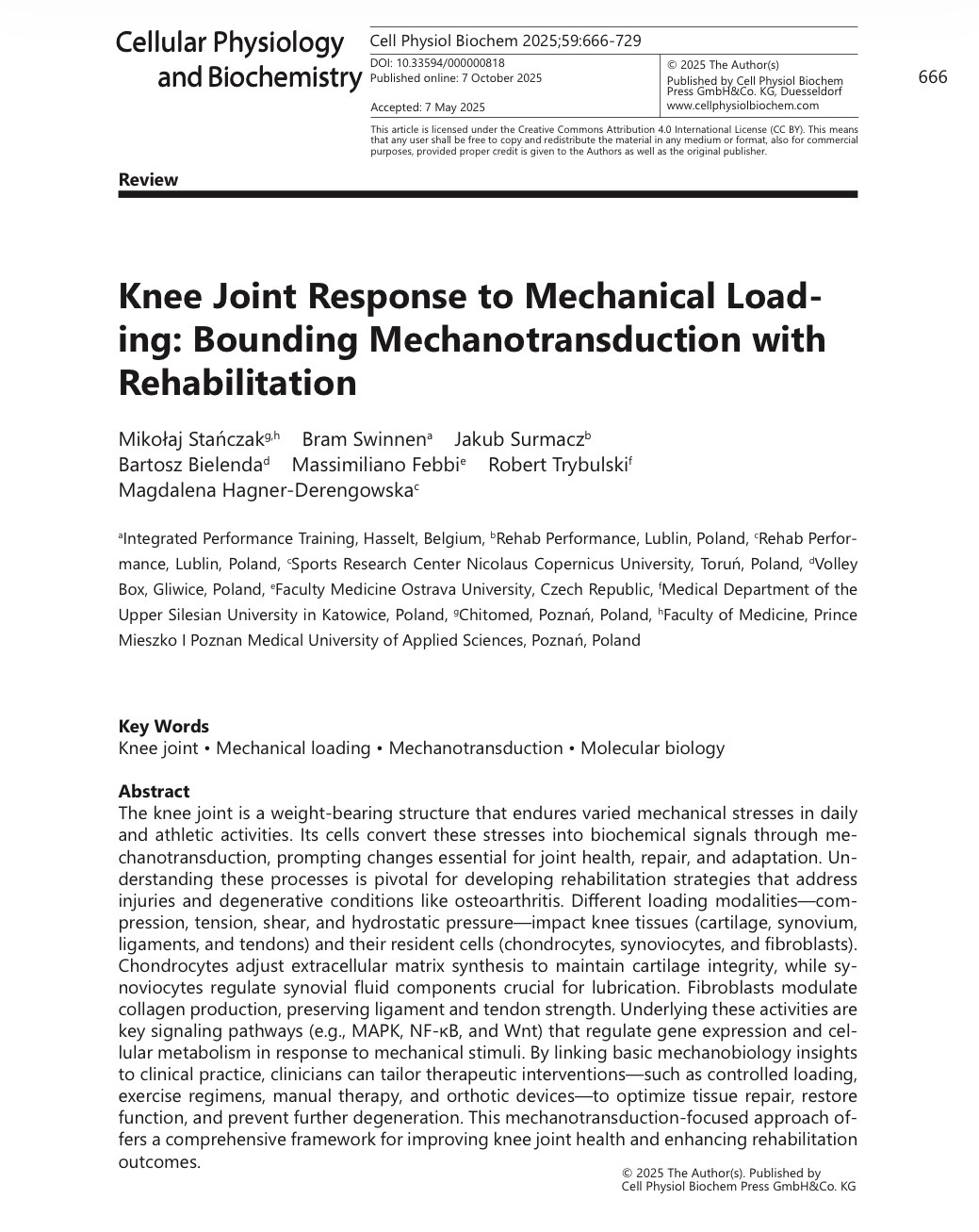
The Knee and Mechanical Loading: A Mechanotransduction-Based Framework for Rehabilitation

Tissue doesn’t adapt to exercises — it adapts to mechanical signals.

How mechanotransduction explains what truly drives knee recovery.

I’m proud to share our new publication on knee mechanotransduction and rehabilitation.

Together with Mikołaj Stańczak, Jakub Surmacz, Bartosz Bielenda, Prof.Dr. Massimiliano Febbi PhD, Robert Tribulski, Magdalena Hagner-Derengowska, we explored one key question:

How can mechanical loading — at the molecular level — accelerate knee rehabilitation?

Because rehab isn’t only about exercises.
It’s about delivering the right mechanical signal at the right biological time.

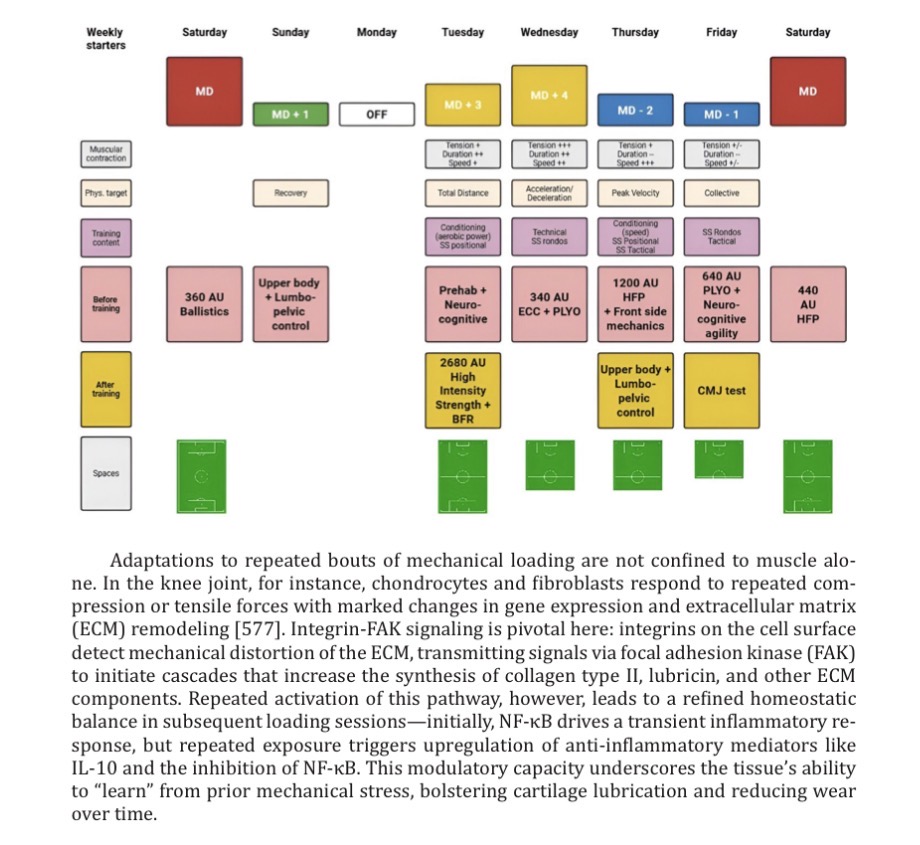
Different tissues — cartilage, synovium, meniscus, tendons, ligaments — all respond in very specific ways to load.
That’s why we argue for stage-specific mechanobiology:

🔁 Match the loading strategy to the phase of healing — inflammation, proliferation, remodeling.
This is how you optimize tendon, ligament and cartilage recovery instead of guessing with sets and reps.

🧩 What makes this review practical?
We translated molecular mechanisms into clinical tools:

✔️ Clear loading windows for under-loaded, optimal and overloaded tissue
✔️ Strength & plyometric guidelines per healing phase
✔️ How to dose early loading after ACL, meniscus or tendon injuries
✔️ How manual therapy + exercise interact through mechanotransduction
✔️ How controlled mechanical stress prevents long-term joint degeneration

The goal:
👉 Build smarter rehab, not more rehab.
👉 Give tissues the mechanical signal they need — exactly when they can use it.

If you work in physiotherapy, sports medicine or performance, this framework will help you design more precise and effective loading progressions.


Full article link